


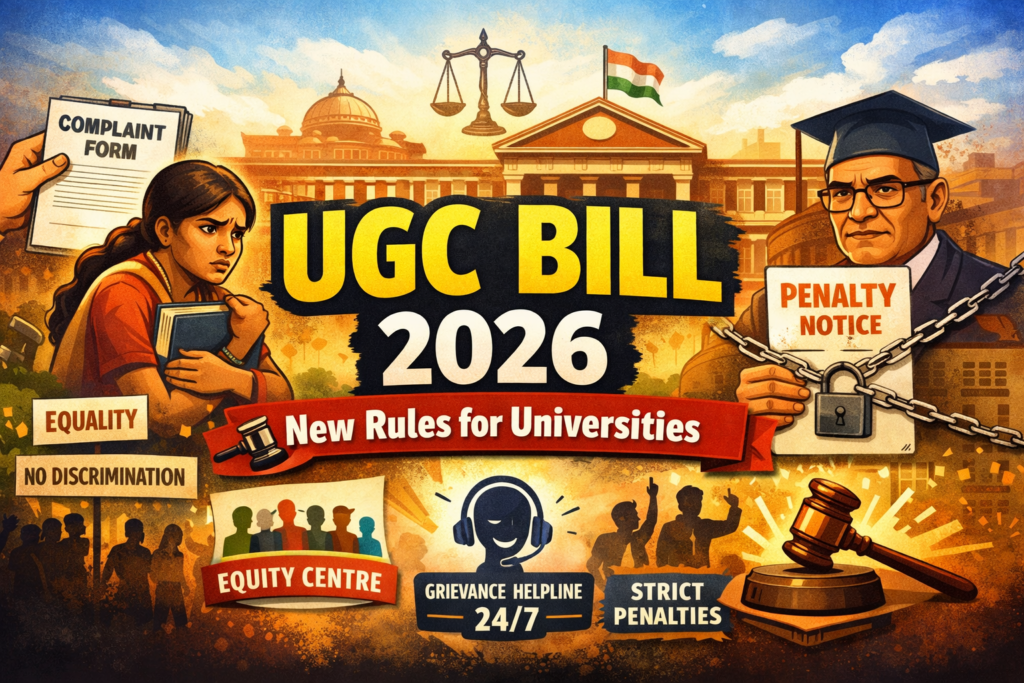
In January 2026, the University Grants Commission (UGC) introduced a new set of regulations that have triggered nationwide discussion, debate, and concern. Officially known as the UGC (Promotion of Equity in Higher Education Institutions) Regulations, 2026, this bill replaces the older 2012 anti-discrimination rules and aims to bring strict, enforceable measures to ensure fairness and equality in Indian colleges and universities.
But what exactly is this bill? Why is it controversial? And how will it affect students, teachers, and institutions?
Let’s understand it in detail.
What Is the UGC Bill 2026?
The UGC Bill 2026 is a regulatory framework designed to prevent discrimination in higher education institutions. It focuses on ensuring equal treatment for students and staff regardless of caste, religion, gender, disability, place of birth, or social background.
Earlier, universities followed guidelines, which were mostly advisory in nature. The new bill changes that completely — it introduces mandatory rules with penalties for institutions that fail to comply.
This is a big shift in India’s education governance.
Why Was a New UGC Bill Needed?
According to UGC data and multiple reports, complaints related to discrimination in universities have increased sharply in recent years. Many students from marginalized communities reported harassment, bias, and lack of institutional support.
The 2012 regulations were criticized for being:
- Weakly enforced
- Lacking accountability
- Ignored by many institutions
The 2026 bill was introduced to make universities legally responsible for ensuring an inclusive and safe campus environment.
Key Features of the UGC Bill 2026
1. Equal Opportunity Centres (EOCs) – Mandatory for All Institutions
Every university and college must now set up an Equal Opportunity Centre.
These centers will:
- Help students from disadvantaged backgrounds
- Provide counselings and support
- Handle discrimination-related complaints
- Conduct awareness programs on equality and inclusion
This step aims to ensure that students have a dedicated place to seek help without fear.
2. Equity Committees in Universities
Each institution must form an Equity Committee with representation from:
- SC, ST, OBC communities
- Women
- Persons with disabilities
- Minority groups
The committee will monitor campus practices and ensure no group is treated unfairly. It also has the power to recommend disciplinary action if violations occur.
3. Fast Grievance Redressal System
One of the most important changes is time-bound grievance resolution:
- Complaints must be acknowledged within 24 hours
- Investigation and action must be completed within 15 working days
This is a major improvement over the earlier system, where complaints often remained unresolved for months.
4. 24/7 Helpline and Online Complaint Portal
Universities are now required to maintain:
- A round-the-clock helpline
- An online grievance portal
This ensures students can raise issues easily, even anonymously, without going through administrative pressure.
5. National Monitoring Committee
UGC will form a National Monitoring Committee to supervise implementation across India.
This committee can:
- Inspect institutions
- Review complaints
- Recommend penalties
- Publish compliance reports
This makes the bill more powerful and enforceable than any earlier regulation.
6. Strict Penalties for Non-Compliance
Institutions that fail to follow the rules can face serious consequences, including:
- Loss of UGC recognition
- Ban on admitting new students
- Disqualification from UGC funding and schemes
- Restrictions on starting new courses
This provision has made universities take the bill very seriously.
Why Is the UGC Bill 2026 Controversial?
While many welcome the bill as a progressive step, it has also triggered protests and criticism.
Concerns Raised by Critics:
- Some groups fear misuse of complaints
- Others say the bill may lead to reverse discrimination
- Universities worry about loss of autonomy
- Teachers’ associations say the rules are too centralised
- There is concern about punishment before fair investigation
Because of these issues, the bill has become a hot topic in political and academic circles.
What Does This Mean for Students?
For students, especially from marginalized communities, the bill offers:
- Faster justice
- Institutional support
- A safer campus environment
- Reduced fear of retaliation
However, students must also understand that false complaints can have serious consequences, and the system should be used responsibly.
What Does It Mean for Teachers and Staff?
Teachers and administrative staff will now be:
- More accountable in behaviour and decisions
- Required to undergo sensitisation training
- Monitored for compliance with equity rules
While this increases responsibility, it also helps create a professional and respectful environment.
Impact on Universities and Colleges
Universities will need to:
- Create new departments and committees
- Train staff
- Set up digital systems
- Maintain records and reports
- Handle complaints transparently
This will increase administrative work, but also improve institutional credibility.
Is the UGC Bill 2026 Good or Bad?
The answer depends on implementation.
If implemented fairly and transparently, it can:
- Reduce discrimination
- Build trust in education institutions
- Protect vulnerable students
- Improve India’s global education image
If misused or over-politicized, it could:
- Create fear
- Harm academic freedom
- Increase unnecessary conflicts
Table of Contents
Final Thoughts
The UGC Bill 2026 is one of the most important education reforms in recent years. It marks a shift from advisory guidelines to strict accountability. Whether it becomes a tool for justice or controversy will depend on how universities, students, and authorities use it.
One thing is clear — higher education in India is entering a new era of responsibility and transparency.
Read More : AI-Enhanced Microlearning: The Future of Fast, Smart, and Personalized Learning

UGC Bill 2026, UGC latest news, UGC new rules, UGC regulations 2026, education bill India, higher education reforms, university rules India, UGC law explained, student rights India, college discrimination law, UGC controversy, education policy 2026, university compliance, equity in education, UGC guidelines, Indian education system, latest government bill, education news India, UGC updates, students and universities


