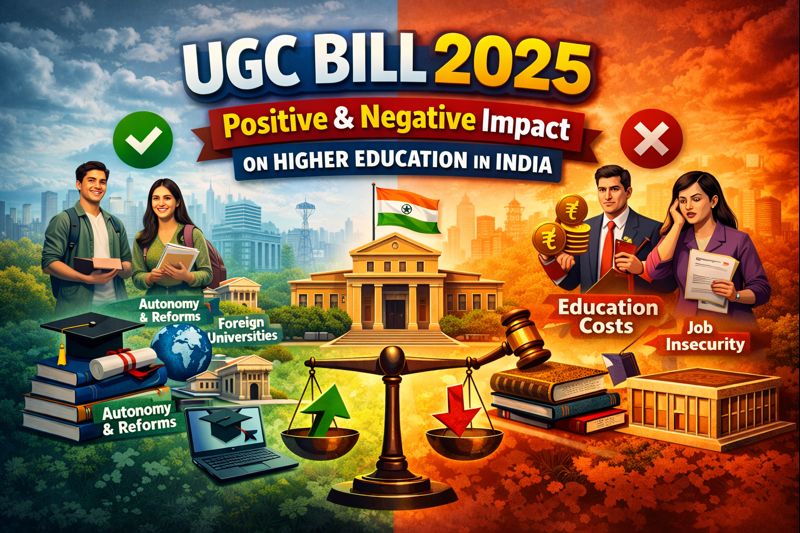
The UGC Bill 2025 (University Grants Commission Draft Regulations) has become one of the most debated topics in Indian higher education. The government claims that the new bill will bring transparency, autonomy, quality control, and global standards to universities. However, teachers, students, and education experts are raising concerns about centralization, loss of academic freedom, and commercialization of education.
In this blog, we’ll explore the positive and negative impacts of the UGC Bill, helping you understand how it may shape the future of Indian universities, colleges, teachers, and students.
What is the UGC Bill 2025?
The UGC Bill 2025 aims to replace the existing UGC Act 1956 with a new regulatory framework. Under the new structure, a Higher Education Commission of India (HECI) is proposed, focusing on:
- Quality assurance
- Accreditation
- Funding separation
- Governance reforms
- Foreign university entry in India
- Digital education expansion
The goal is to make Indian higher education more competitive, flexible, and globally aligned.
✅ Positive Impact of the UGC Bill
1. Increased University Autonomy
One of the major benefits of the UGC Bill is that it promises greater academic autonomy. Universities will be able to:
- Design their own curriculum
- Introduce industry-oriented courses
- Collaborate with global institutions
This flexibility can make Indian degrees more job-relevant and future-ready.
2. Focus on Quality Education
The new bill emphasizes quality-based ranking, accreditation, and performance. Institutions will be judged on:
- Research output
- Teaching standards
- Student outcomes
- Infrastructure
This can push colleges to improve facilities and faculty quality, making Indian education more competitive globally.
3. Entry of Foreign Universities in India
The UGC Bill supports foreign universities setting up campuses in India, which can:
- Reduce student migration abroad
- Offer global exposure at lower cost
- Increase healthy competition among Indian universities
This aligns with NEP 2020’s vision of internationalization of education.
4. Digital and Online Learning Boost
The bill supports online degrees, hybrid learning models, and EdTech partnerships, benefiting students from rural and remote areas.
5. Separation of Funding and Regulation
The government plans to separate funding from regulation, reducing bureaucratic delays. This could make funding more efficient and transparent, especially for research institutions.
❌ Negative Impact of the UGC Bill :
1. Fear of Centralization of Power
One of the biggest concerns is that the UGC Bill gives too much control to the central government. The proposed structure reduces the role of:
- State governments
- Universities’ internal bodies
- Academic councils
This could weaken federalism in education and limit academic freedom.
2. Threat to Teachers’ Job Security
Many teacher unions believe that the bill may lead to:
- Contract-based hiring
- Performance-linked pay
- Reduced tenure security
This could increase job pressure and reduce long-term research quality, as teachers may focus more on metrics than mentoring.
3. Commercialization of Education
With private and foreign universities entering easily, there is a fear that education may become a profit-driven business. Higher fees could make quality education inaccessible to students from middle-class and poor families.
4. Weakened Role of UGC
The UGC has historically protected:
- Teacher service conditions
- Pay scales
- Minimum standards of education
Replacing it may remove an important buffer between universities and political influence, raising questions about independence.
5. Unequal Impact on State Universities
State universities, especially in rural and backward regions, may struggle to meet new accreditation norms due to:
- Lack of funding
- Poor infrastructure
- Faculty shortages
This could widen the gap between elite institutions and regional universities.
Long-Term Impact of UGC Bill on Students and Teachers
If implemented carefully, the UGC Bill could modernize Indian higher education and make it globally competitive. However, poor implementation may increase inequality, reduce academic freedom, and promote privatization.
For students, the bill brings:
- More course choices
- Global exposure
- Digital learning options
But also: - Higher fees
- Competitive pressure
- Reduced state support
For teachers, it offers:
- Performance recognition
- Research funding opportunities
But also: - Job insecurity
- Administrative control
- Reduced independence
Conclusion: Is the UGC Bill Good or Bad?
The UGC Bill 2025 is a double-edged sword. It has the potential to transform Indian education if implemented with transparency, consultation, and safeguards. But ignoring concerns of teachers, states, and students could lead to serious long-term damage to the education ecosystem.
The need of the hour is dialogue, balanced reforms, and protection of academic freedom.
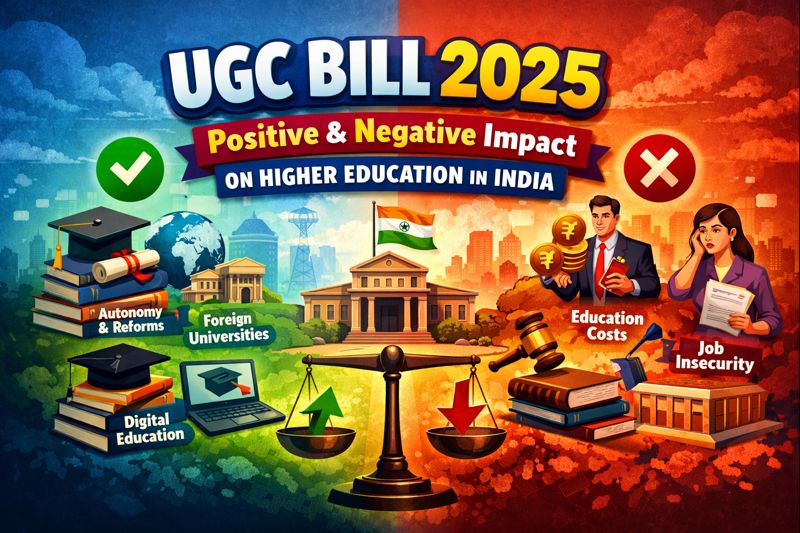
Table of Contents
UGC Bill 2025, UGC new bill impact, higher education reforms India, NEP 2020, academic freedom, foreign universities in India, digital education India, university autonomy, UGC controversy, education bill India, privatization of education, online degrees India